The Hands Are Holding Robots Back. We Spoke With Who's Solving This.
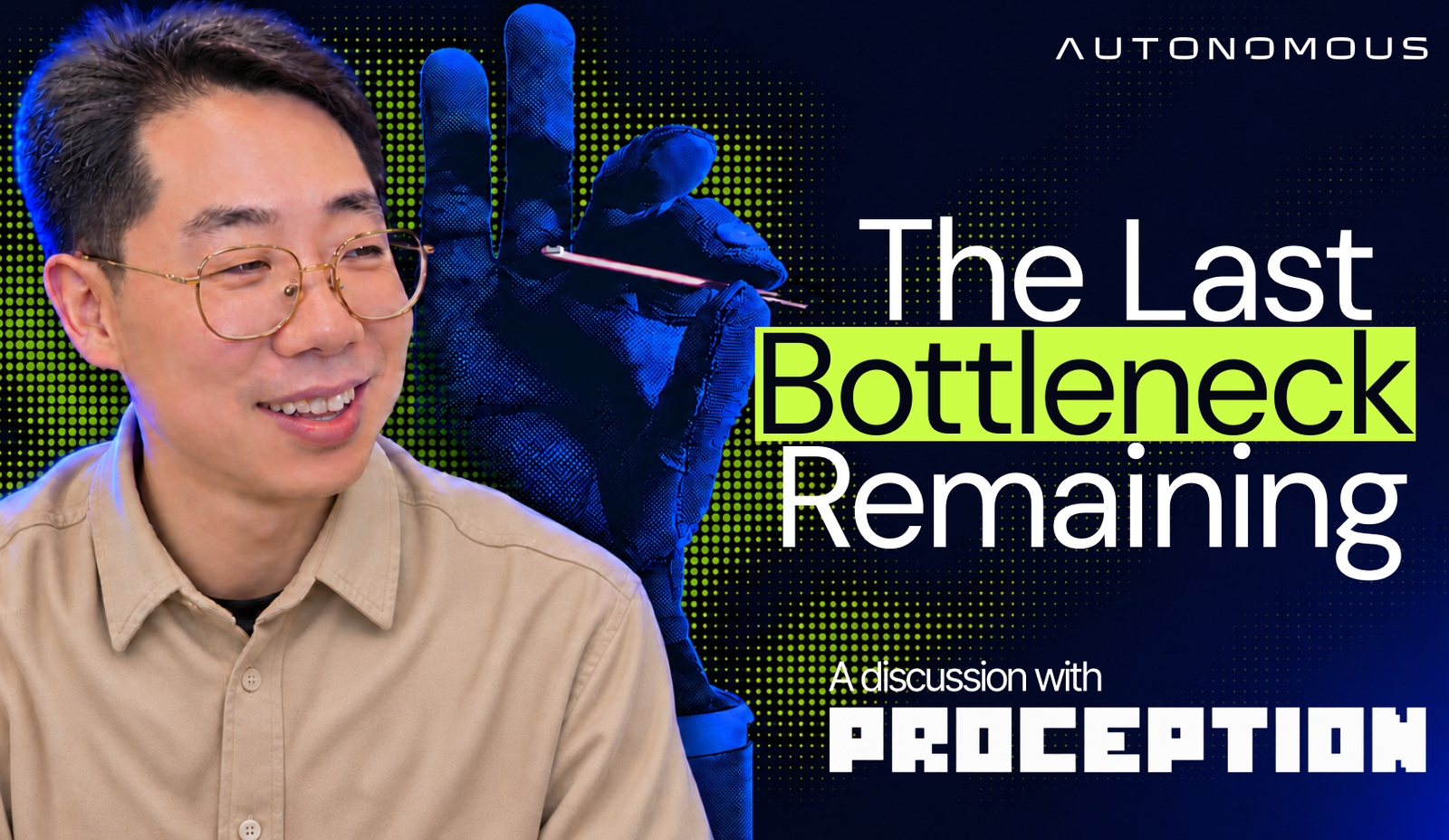
Proception co-founder and CEO Jay Li explains why better robot intelligence needs more capable hands. In this AUTONOMOUS interview, he discusses tactile sensing, learning from human demonstrations and the challenge of manufacturing dexterous hands at scale.
This episode
Watch the full episode on our X account https://x.com/autonomousevent
As robot intelligence improves, the demands on the hardware become harder to ignore. A model can identify an object and decide what to do with it, but carrying out that decision depends on a hand that can establish a secure grip, sense what is happening at the point of contact and survive doing it repeatedly. For Jay Li, co-founder and CEO of Proception, this is where a major constraint on useful humanoids is emerging.
Jay joins AUTONOMOUS to discuss what it takes to build those hands. After working at Apple and Tesla, he co-founded Proception to tackle dexterous manipulation: giving robots the ability to handle objects with the control and versatility that useful work requires. The conversation covers the hand itself, the tactile glove used to collect human demonstrations, and the challenge of turning both into products that can be manufactured reliably.
The engineering involves compromises that are easy to miss in a demonstration. Jay explains why Proception uses tendons, why it has kept a human-shaped, five-finger design, and how it balances strength, dexterity and sensing within that form. The same compromises apply to the glove. Its 96 sensors have to keep working as the material bends and stretches; adding more sensing points only helps if the result remains reliable and the models can use the additional information.
That leads to a second problem: where the training data comes from. Video can show how a person moves an object, but it does not directly record the contact forces involved. Jay uses the example of lifting a drinks can to explain the difference between seeing fingers touch a surface and knowing the grip is secure. Proception's approach is to collect tactile information from people wearing gloves, then reduce the differences between the human demonstrations and the robot that learns from them. Jay also describes an early model trained entirely on human data, while making clear that it represents a small step.
The conversation returns repeatedly to scale. Collecting demonstrations during ordinary work could expand the supply of data, but customers retain ownership of what they collect. Building more hands requires consistent processes, production experience and hardware that lasts. Jay discusses a two-million-cycle rating for the hand, the difficulty of automating a manufacturing process that is still changing, and the people Proception needs to help it grow.
What makes this conversation useful is the connection between these problems. The hand, the sensing and the training data all affect one another. As the intelligence improves, the practical test remains whether the robot can carry out the work reliably, over and over again.
Timestamps
- 00:00 — Jay Li and the ambition behind Proception
- 01:35 — Why build a humanoid alongside the hands?
- 03:44 — Unexpected customers and the demand for dexterity
- 06:07 — Building hands in Mountain View
- 07:48 — Why automating production is still difficult
- 11:41 — Tendons, five fingers and the trade-offs of hand design
- 16:20 — The tactile data that video cannot capture
- 19:58 — Why more sensors are not always better
- 22:54 — Closing the gap between human demonstrations and robot hands
- 24:55 — An early model trained on human data
- 27:15 — Collecting data during ordinary work
- 30:15 — Using the hands with other models and training methods
- 31:10 — Better brains, durable hands and the hardware bottleneck
- 32:48 — Who Proception needs to hire
- 36:48 — A five-year ambition and the wider robotics ecosystem
- 40:31 — International customers and US manufacturing
- 42:00 — What keeps a robotics founder going
- 44:33 — Favourite robots and what comes next
- 46:04 — Hiring, updates and closing
Episode walkthrough
A section-by-section account of Jay’s discussion, edited from the interview for readability. Plans, forecasts and product details reflect what was discussed at the time of recording.
00:00 — Jay Li and the ambition behind Proception
Jay Li co-founded Proception after studying at Stanford and working at Apple and Tesla. His focus is dexterous manipulation: giving robots hands capable of doing useful work.
Human-level capability is the goal, but Jay does not describe a point at which the hand will be finished. He sees development as a continuing process of getting closer to the versatility of human hands.
01:35 — Why build a humanoid alongside the hands?
Proception’s humanoid prototype, discussed in the interview as a project planned for 2027, gives its hands a body on which to demonstrate useful work. Some customers need more than a standalone hand; they also need a practical example of how to integrate it into a robot.
Jay describes the humanoid as a reference design for those customers. Proception intends to serve companies that want the hands alone as well as those that need a body to carry them. He says this direction remains consistent with the company’s original master plan.
03:44 — Unexpected customers and the demand for dexterity
Demand for Proception’s hardware has extended beyond the robotics developers and AI researchers Jay expected to serve. He describes customers exploring connections between the hands and human muscle signals, opening up uses outside the company’s initial assumptions.
Jay sees substantial potential demand for dexterous manipulation. In his view, the immediate constraint is how many hands Proception can produce. The commercial opportunity therefore leads directly back to manufacturing capacity.
06:07 — Building hands in Mountain View
Proception builds its hands in Mountain View. At the time of the interview, Jay estimated that one person could assemble a hand from start to finish in less than a day.
The larger challenge is making that process repeatable across a growing production team. Jay describes a ramp from single-digit monthly output toward hundreds of hands per month, with thousands as a further target. Reaching those volumes requires engineering work to keep quality consistent, alongside hiring the technicians and engineers who support production.
07:48 — Why automating production is still difficult
Building robotic hands does not yet mean that robots perform most of Proception’s own assembly. Jay explains that the production process is still changing as the team refines the design and how it is built. That makes it difficult to specify a fixed sequence for conventional automation.
He expects automation to become more important as volumes rise. Flexible manufacturing is particularly attractive, and Proception is exploring whether its own robots could eventually carry out work on its production line. Jay also describes discussions with industrial companies about collaborations to support the ramp.
11:41 — Tendons, five fingers and the trade-offs of hand design
Proception’s tendon-driven design takes inspiration from the way human hands move. Jay says tendons help the company package 22 degrees of freedom into a human-sized hand while retaining strength. The design has to accommodate sensing as well as movement, so improving one capability cannot come at the expense of everything else.
The five-finger shape also serves a practical purpose. People already understand how to present a hammer or a pair of scissors to a human hand, and they have expectations about how it will grasp the tool. Jay argues that a familiar form makes it easier to build one product for different applications.
That choice connects to training data too. Human demonstrations show five-finger hands interacting with objects. A similar robotic form reduces the translation required to apply those demonstrations to a different mechanism.
16:20 — The tactile data that video cannot capture
First-person video is becoming increasingly available for training robotics models. Jay identifies contact information as a missing part of that record, particularly when the hand obscures the interaction or the task requires precise, fast manipulation. Proception’s glove is designed to capture that information directly from human demonstrations.
He expects large volumes of visual data to be complemented by smaller quantities of higher-quality data that includes tactile sensing. The glove adds information about the interaction between the hand and the object.
Lifting a drinks can illustrates the distinction. A camera may show fingers touching its surface without establishing whether the grip is secure enough to lift. Jay explains that uncertainty about the moment of contact can also slow an action: the robot has to establish its grasp before moving the object.
19:58 — Why more sensors are not always better
The glove has 96 tactile sensors, but Jay does not treat a higher sensor count as an automatic improvement. Sensors mounted on a rigid surface can be protected by that structure. A wearable glove must keep working as it bends repeatedly with the person’s hand.
Proception therefore prioritises the wearable form and reliability. Jay also argues that sensor development needs to keep pace with what models can use. He expects higher resolution and additional sensing modalities over time, while questioning the value of collecting more detail before the rest of the system can benefit from it.
22:54 — Closing the gap between human demonstrations and robot hands
A human demonstration and a robot’s attempt to reproduce it involve different bodies. Proception aims to reduce this embodiment gap by designing the robotic hand to resemble the human hand in its shape and movement capabilities.
Jay says the sensors worn by the person and the robot are identical, reducing differences in the contact information each receives. Designing the hand and glove together is intended to make demonstrations more transferable.
That approach shaped development from the beginning. Jay describes nearly two years of work before shipping products, with the team choosing technologies around the goal of reducing the gap while building hardware that could be manufactured at scale.
24:55 — An early model trained on human data
At the time of the interview, Proception was preparing to present and open-source an early model trained entirely on human data. Jay says the training used no teleoperation or robot data, addressing a question the company had pursued from its earliest days: could a robot learn tasks directly from human demonstrations?
The result brought together the hardware and data-collection approach developed over the preceding two years. Jay is careful about its significance. He describes a small step in the right direction and cautions against treating it as a large, finished product.
27:15 — Collecting data during ordinary work
Collecting demonstrations through teleoperation can require buying and transporting a robot, setting up the scene and providing engineering support. Jay contrasts that process with sending gloves to the place where a person already performs the work.
The person can then collect data while carrying out ordinary tasks, rather than dedicating every action solely to recording a demonstration. Jay argues that this could lower collection costs and, more importantly, make it possible to gather data at a scale that money alone cannot achieve through teleoperation.
Customers retain ownership of the data recorded with their gloves. Proception does not automatically collect those recordings. Jay discusses buying data from customers in the future as a possible way to access it.
30:15 — Using the hands with other models and training methods
Customers do not have to adopt Proception’s human-demonstration approach to use the hand. Jay explains that it can operate as hardware controlled by a customer’s own model.
He describes support for different development approaches, including simulation-based training, imitation learning and reinforcement learning. Collecting demonstrations with the Proception glove provides another route to training, rather than replacing every other way of using the hand.
31:10 — Better brains, durable hands and the hardware bottleneck
Jay sees robot intelligence improving rapidly and expects that progress to continue. As the models become more capable, he believes the hands are emerging as a major constraint on what the complete robot can achieve.
The requirement is broader than dexterity in a short demonstration. A useful hand needs tactile sensing and sufficient strength, while remaining robust through repeated use. Jay gives Proception’s hand a rating of two million cycles. At the time of the interview, he estimated a working life of roughly six months to a year depending on how intensively it was used.
32:48 — Who Proception needs to hire
Proception’s hiring needs reflect its move toward higher production volumes. Jay places particular value on people who have already taken mechanical products from small-scale builds into larger manufacturing operations. The team also needs specialists in fields such as tactile sensing, where the pool of experienced candidates is limited.
Experience at a large company can help, but Jay does not treat it as a requirement for strong engineering work. He describes hiring recent graduates with substantial undergraduate projects and credits AI tools with helping individuals build more ambitious systems than they could have managed a few years earlier.
36:48 — A five-year ambition and the wider robotics ecosystem
Jay’s five-year ambition is to make dexterous manipulation accessible wherever it is needed, including factories, warehouses and homes. He frames Proception’s goal around delivering that capability, rather than choosing a fixed identity as only a hardware, data or model company.
His forecast for the wider industry includes one or two vertically integrated companies alongside a broader ecosystem of suppliers. Tesla is one company he considers a likely integrated player. He expects other businesses to find substantial opportunities by contributing specialised capabilities.
Robotics, in his view, will develop differently from a software-only market. Physical products are harder to manufacture and distribute at scale, leaving room for multiple companies to participate. He compares that structure with industries such as consumer electronics and personal computers.
40:31 — International customers and US manufacturing
Proception was already reaching customers across at least three continents when the interview took place. Jay describes international interest arriving despite limited marketing activity outside the United States.
The main obstacles he identifies are customs and logistics. Proception has manufactured in the United States from the beginning, and supplying customers abroad adds the practical work of moving that hardware across borders.
42:00 — What keeps a robotics founder going
For Jay, motivation comes from seeing the hardware begin to work. A finger moving, a wrist responding or a tactile signal appearing on a screen can make a small development milestone meaningful to the whole team.
Those moments help sustain a project that takes years to bring to market. Jay also points to patience: the team understands the difficulty of the problem and expects progress to require sustained effort. Working on something he considers meaningful gives that effort a purpose.
44:33 — Favourite robots and what comes next
Asked about his favourite robot, Jay begins with Proception’s own project. He also expresses admiration for Tesla’s Optimus and Unitree’s G1.
His broader interest is in what comes next. He sees robotics improving quickly enough that the most compelling machine may be the one arriving next month or next year. That pace of development keeps him looking ahead to the next generation of hardware.
46:04 — Hiring, updates and closing
Jay closes by inviting people to follow Proception’s progress and connect with the team. At the time of the interview, the company was hiring, and he pointed listeners toward his updates on X for news about the robot, hands and sensing technology.
The event
AUTONOMOUS 2027
The conference behind this reporting: April 13-14, 2027 at Pier 27, San Francisco. Two days of founders, engineers and investors building robotics and physical AI.