Almond Bot Builds The Hardware That Builds Hardware.
From grocery store work to Chicago factory floors, Almond Robotics’ founders saw how hardware limited what robots could do. Now co-founder Saba Khalilnaji is building toward a factory where robots help make other robots.
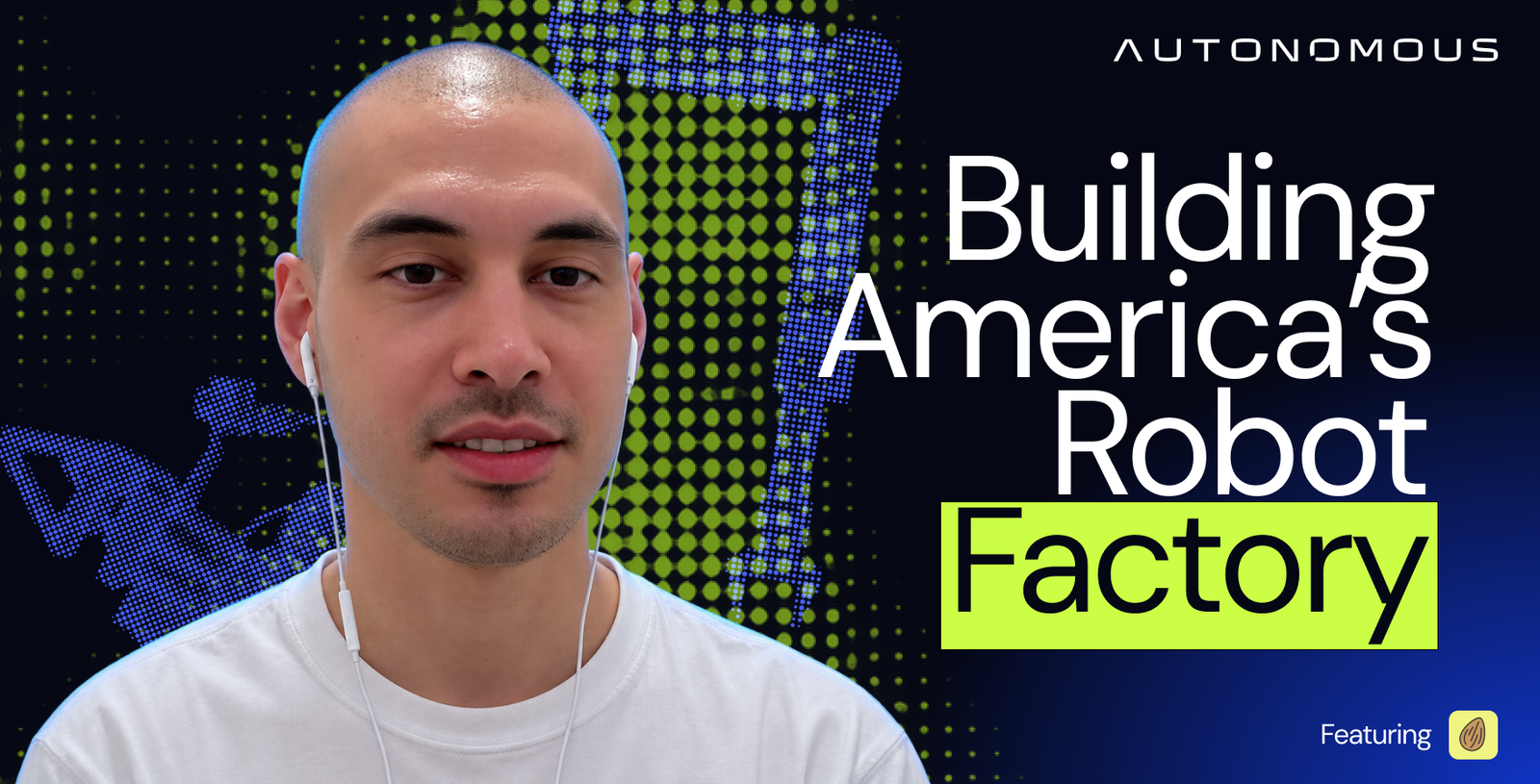
Almond co-founder and CEO Saba Khalilnaji explains how factory integration work shaped the company’s robots, why manufacturing may matter more than data in the long run, and what it will take to put robots to work building other robots.
AUTONOMOUS Editorial · 10 min read
This episode
Watch the full episode on our X account: https://x.com/autonomousevent
As robot models improve, the physical work still has to be done by hardware. An arm can perform a task on a carefully arranged tabletop and still fall short when it has to reach into a CNC machine, press a control or move a load in a real factory. For Almond co-founder and CEO Saba Khalilnaji, that gap is where the company’s work begins.
Almond’s founders came from grocery-store work and spent six months integrating systems in Chicago factories. They saw that existing hardware could hold back the automation they wanted to build. Axol is Almond’s dual-arm robot; Jelly is a powered mobile base; Mantis is a handheld gripper system for collecting manipulation data. The company’s broader ambition is to build “America’s robot factory” and make the robot forms its customers need.
The interview gets into the practical constraints behind that ambition: reach and payload, protected cables, software and customer support. Saba also describes an early Axol deployment that exposed a movement the team’s tests had missed. The fix meant changing the hardware. Moving quickly helped, but suppliers, lead times, manufacturing choices and safety requirements all shape how quickly a design can change.
Almond is also building an open-source ecosystem around its hardware. Saba explains why the company focuses on task-specific post-training data rather than trying to become a data business, how customers contribute improvements, and why he thinks manufacturing—not data—may be the long-term moat. The conversation moves from small-team hiring and international repairs to the first milestone for Almond’s factory: Axol contributing useful work on a production line, with robots eventually building other robots.
A chapter-by-chapter account of Saba’s discussion, edited for readability. Product details, plans and hiring reflect what was discussed at the time of recording.
Timestamps
- 00:00 — Saba Khalilnaji and Almond’s ambition
- 00:47 — Mantis 1.2 and customer feedback
- 02:13 — From grocery stores and Chicago factories to Almond
- 04:20 — Who is buying Axol?
- 05:44 — America’s robot factory
- 06:43 — International shipping and robot repairs
- 08:32 — Data and the long-term moat
- 10:36 — VR teleoperation, Mantis and datasets
- 12:53 — Open source as a business advantage
- 15:15 — AI models, agents and Almond’s internal ERP
- 17:44 — What Almond keeps closed source
- 19:54 — Building a small team
- 22:53 — Customer feedback and a hardware redesign
- 25:05 — Getting parts from suppliers quickly
- 26:17 — Build times and robots building robots
- 27:44 — Axol’s head and tactile grippers
- 30:26 — Vertical integration and factory safety
- 33:12 — International sales and EU safety requirements
- 36:35 — From TubeMogul and DoorDash to two YC batches
- 40:40 — What keeps Saba going
- 44:34 — Closing and hiring
00:00 — Saba Khalilnaji and Almond’s ambition
Saba introduces Almond as a company building “America’s robot factory.” Its first product, Axol, is a dual-arm robot designed to work beyond tabletop demonstrations. He also introduces Jelly, a holonomic mobile base that can carry Axol around a workspace.
The opening sets up the company’s larger idea: build hardware for work in the physical world, then make different robot embodiments as customers need them.
00:47 — Mantis 1.2 and customer feedback
Mantis is Almond’s handheld data-collection gripper. Its end effector is designed to match the one on Axol, so people can collect manipulation demonstrations without teleoperating the robot itself. The interview frames it as a tool for researchers and physical AI teams collecting data, training models and running evaluations on hardware.
Saba describes Mantis 1.2 as a revision shaped by reliability issues and customer feedback. Changes include a locking cable connector and a trigger button for starting and stopping recordings.
02:13 — From grocery stores and Chicago factories to Almond
Saba says the founders had experience in grocery-store environments, then spent six months after Y Combinator working as integrators in Chicago factories. Visiting factory floors made the gap between tabletop demonstrations and production tasks clear: machines cannot always be rearranged to suit a robot.
A useful factory robot has to reach into machines, operate buttons and doors, carry a meaningful payload, fit into tight spaces and protect its cables. Saba adds software reliability and customer support to that list of requirements.
04:20 — Who is buying Axol?
Asked whether customer demand has surprised him, Saba says it has come from different industries. His takeaway is that the need for robots is not confined to one sector and could have broad economic effects.
The conversation then turns to forecasts for the humanoid market. Those figures are raised by the interviewer; the discussion is a point of context, not a forecast from Almond.
05:44 — America’s robot factory
Saba describes Almond’s goal as building a factory in the United States and making whichever robot embodiments customers ask for. He says the company is based in California to stay close to customers, many of whom are in the Bay Area, with others in places such as New York and Texas.
The ambition is customer-led: the factory’s output is not limited to one form of robot if different embodiments are needed for different work.
06:43 — International shipping and robot repairs
Saba says Almond ships to international customers and designs its hardware to be repairable. Open documentation and modular construction are meant to let customers access information and replace a joint if one fails, then return the part for inspection.
At the time of the interview, Saba said the company had not yet needed to send someone abroad for a repair. He also discussed the company’s manufacturing-defect warranty and service plans.
08:32 — Data and the long-term moat
Almond does not want to become a data company. Saba describes its focus as post-training data tied to a customer’s specific task and environment, rather than collecting the largest possible volume. He suggests that useful training may require hours of data, not necessarily enormous datasets.
On the broader question of where long-term value will sit, Saba argues that data could become inexpensive and widely available. He thinks manufacturing may prove to be the more durable advantage—and connects that view to Almond’s factory plans.
10:36 — VR teleoperation, Mantis and datasets
Almond offers software as well as hardware, including a browser-based VR teleoperation system. Saba says many teams use headsets to collect demonstrations, while some are beginning to explore Mantis as another way to gather data. He describes reducing reliance on teleoperation as a goal because it can be difficult and unpleasant.
He also explains a shift in Almond’s data strategy: rather than focus on releasing its own trained model weights, the company is publishing datasets that customers can use with the models they choose. At the time of recording, Saba said Almond had released a dataset of roughly 1,000 episodes.
12:53 — Open source as a business advantage
Almond’s open-source approach covers more than datasets. Saba describes customer contributions to the software and Mantis, including a web dashboard that lets users control Axol with keyboard inputs and plan movements.
For Almond, those contributions help the product improve while giving customers a role in the community around it. Saba says the company benefits when customers can modify and extend the tools they use.
15:15 — AI models, agents and Almond’s internal ERP
The conversation turns to the models the team uses for software and robotics. Saba distinguishes coding tools from models used to control robots, then describes how agents support Almond’s internal operations.
The company’s internal ERP runs on agents and helps technicians who assemble Axol ask questions and open pull requests. Saba says mechanical engineers have also begun making software changes through these workflows. Almond keeps this company-specific internal system closed source.
17:44 — What Almond keeps closed source
Asked what robotics companies should keep private, Saba points to internal tools such as Almond’s ERP. He says much of the rest can be made accessible as software becomes easier to build.
The discussion broadens into whether nontechnical customers will want to build their own robots. Saba remains optimistic that better tools and open-source work can make room for new ideas, even if most people will still rely on companies to build and support the products they use.
19:54 — Building a small team
Saba says Almond had seven people at the time of the interview. Finding people who are both capable and aligned with a company’s culture is one of the difficulties of growing a team.
He describes the team as young, with many members recently out of college, and argues that a mix of backgrounds can be valuable. People new to robotics may question assumptions that experienced teams take for granted. The interview returns to hiring at the end.
22:53 — Customer feedback and a hardware redesign
Saba says Almond listens for customer feedback that comes up repeatedly, then moves quickly to address it. One of the first customer deployments exposed an arm movement the team had not encountered in its own tests: when the arm crossed the robot’s chest, it could strike the body.
This required a hardware change, not a software adjustment. Saba says the team redesigned the part in about an hour, rushed the order and had replacements within two days. He presents the episode as a reason to ship early and learn from real use.
25:05 — Getting parts from suppliers quickly
The speed of that redesign depended partly on knowing suppliers’ design-for-manufacturing rules. Saba says Almond has learned what each supplier can produce quickly and which finishing steps add time; powder coating and hardware, for example, can each add a day.
When speed matters, the team focuses on what a part actually needs and skips optional finishing. Saba says Almond can do most of the work in-house, while outsourcing cutting and bending.
26:17 — Build times and robots building robots
Asked about production time, Saba says Almond could build two Axol arms in two days at the time of recording, with timing depending on what goes wrong. He then describes a first major factory milestone: Axol contributing useful tasks to a production line reliably enough that people can assign work and trust it will get done.
The further goal is a factory where robots help build other robots. Saba connects that ambition to work with Physical Intelligence, while describing it as a goal rather than a completed state.
27:44 — Axol’s head and tactile grippers
Saba says an Axol head was taking longer than expected because appearance affects how people perceive a robot. The design also has to fit the company’s goal of keeping its supply chain simple, without adding unnecessary parts or new actuators.
The discussion turns to tactile sensing. Almond was talking with sensor suppliers and exploring tactile grippers, with the idea of collecting contact information at the gripper tips. Saba says the sensing components are specialized, so Almond is speaking with companies that build them.
30:26 — Vertical integration and factory safety
Saba argues that depending on outside suppliers for critical parts can put a company and its production line at risk. Almond had moved wire-harness manufacturing in-house after struggling to find suppliers who could meet its specifications and deadlines.
But bringing production in-house adds responsibilities. Factory use requires attention to safety, relevant ISO standards and third-party testing. Saba describes the verification process as long, showing how control over manufacturing can speed iteration while adding compliance work.
33:12 — International sales and EU safety requirements
Saba says international customers can generally order through Almond’s website, while logistics remain a manual part of the process. He notes that international shipping involves coordination that is not yet easy to automate.
The conversation also touches on European safety expectations. Saba says Axol has safety features, but requirements depend on the customer’s application; in some cases, a protective cage may be the practical route. Almond supports customers as they work through those requirements.
36:35 — From TubeMogul and DoorDash to two YC batches
Saba traces his background through several startups. He worked at TubeMogul, later acquired by Adobe, and spent six and a half years at DoorDash. He later became CTO of Conduit, a company focused on coordinating warehouse traffic, before joining Y Combinator for a second time with Almond.
He says work at fast-growing startups taught him to recognize operational problems worth solving. That experience informed his move from software and logistics toward building robots and the manufacturing systems behind them.
40:40 — What keeps Saba going
Asked what motivates him, Saba recalls growing up with science fiction that made robots seem like an expected part of everyday life. He wants robots to help people at home and in hospitals, and says that imagined future keeps him going through the stress of building a startup.
“I just want to help make it happen,” he says. The closing thought ties Almond’s factory ambition to a wider hope that useful robots will eventually become part of ordinary life.
44:34 — Closing and hiring
In the final exchange, Saba says Almond was hiring a founding robotics software engineer and a founding robotics mechanical engineer. He describes the work as building open-source robot platforms for researchers and others.
That hiring note reflects the time of the interview. The company’s closing invitation is for people interested in building the next generation of open-source robot platforms to reach out.
The event
AUTONOMOUS 2027
The conference behind this reporting: April 13-14, 2027 at Pier 27, San Francisco. Two days of founders, engineers and investors building robotics and physical AI.