7,000 humanoid robots sold in 2025; forecasts say 1.2 million a year by 2030
IFR’s first global count of humanoid robots shows a market that is still tiny and mostly confined to research labs, even as forecasts bet on a 170-fold jump to 1.2 million a year by 2030.
 By Anu Parthiban2 min read

A humanoid robot figure on display. Photo: Igovar / Pexels
The International Federation of Robotics (IFR) has counted the robot category that dominated 2026: about 7,000 humanoid robots were sold worldwide in 2025. To put that in proportion: factories installed 603,307 conventional industrial robots in the same year, so humanoids were only about 1% of the new robots the world added in 2025.
And the robots already working in the world’s factories reached a record 5,079,078, which is more than 700 industrial robots in operation for every single humanoid sold last year.
Most humanoid robots sold in 2025 went to labs, not factories
Many of the humanoids sold in 2025 were not doing productive work. Universities, research labs, and companies bought them to collect human-movement data to train AI models.
Nearly three-quarters of the humanoid sales by Unitree, one of the largest makers, went to developers and academic institutions rather than to anyone running a robot on a production line, as per reports.
Where carmakers are using humanoids, they are running small trials, with “single-digit or sometimes double-digit numbers of robots in their plants,” IFR general secretary Susanne Bieller told Reuters.
The IFR report itself states that humanoids are “still on the verge of making the leap from laboratories to pilots, let alone real deployments”. It names three things holding them back, which are safety and reliability, a shortage of training data, and the absence of a clear business case.
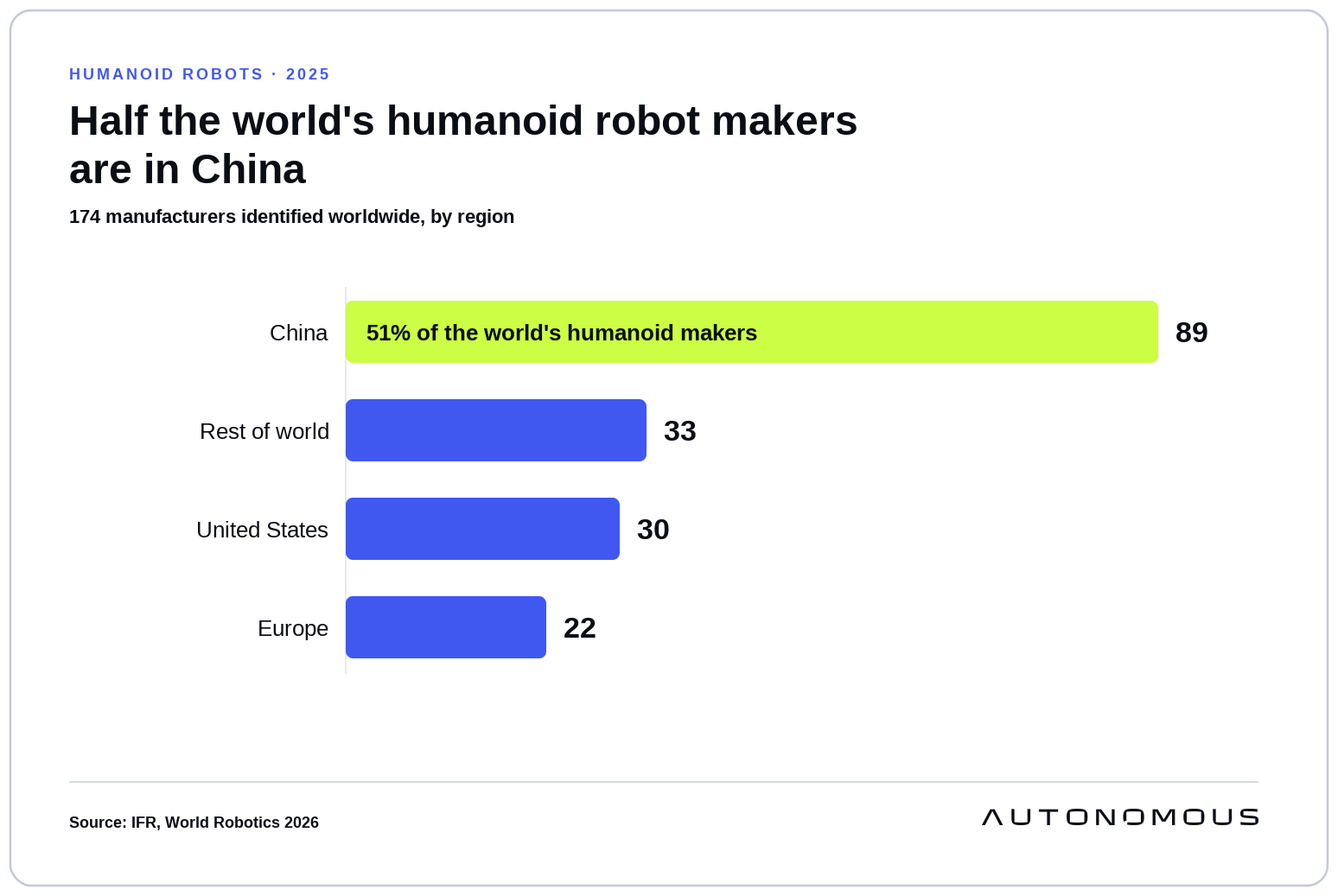
174 humanoid robot makers, more than half in China
Nevertheless, companies are entering the field in large numbers. IFR identified 174 humanoid robot manufacturers worldwide. More than half, 89, are in China, ahead of the rest of the world (33), the United States (30), and Europe (22).
IFR links the wave of new companies to recent breakthroughs in generative AI, which is the bet the whole category rests on: that the software will catch up with the hardware.
Humanoid shipment forecast assumes a 170-fold jump by 2030
The forecasts for the humanoid category are enormous. Bank of America Global Research expects global humanoid shipments to reach 90,000 in 2026 and 1.2 million a year by 2030, driven largely by China’s manufacturing base and state support.
The distance between 7,000 robots, most of them in labs, and 1.2 million a year in real deployment is the single biggest question in robotics, and the number worth tracking every quarter.
For now, the robot count is clear. The robots that run the world’s factories do not look like the robots that raised the most money in 2026. “Industrial automation is progressing at high speed,” IFR president Jane Heffner said. Almost none of that speed is humanoid.
Read next


The event
AUTONOMOUS 2027
The conference behind this reporting: April 13-14, 2027 at Pier 27, San Francisco. Two days of founders, engineers and investors building robotics and physical AI.