53% of the world's new robots now go to factories like food, metal and plastics, not carmakers
General industry took 53% of the world's new robots in 2025, overtaking carmakers and electronics, according to IFR's World Robotics 2026 report.
 By Anu Parthiban3 min read
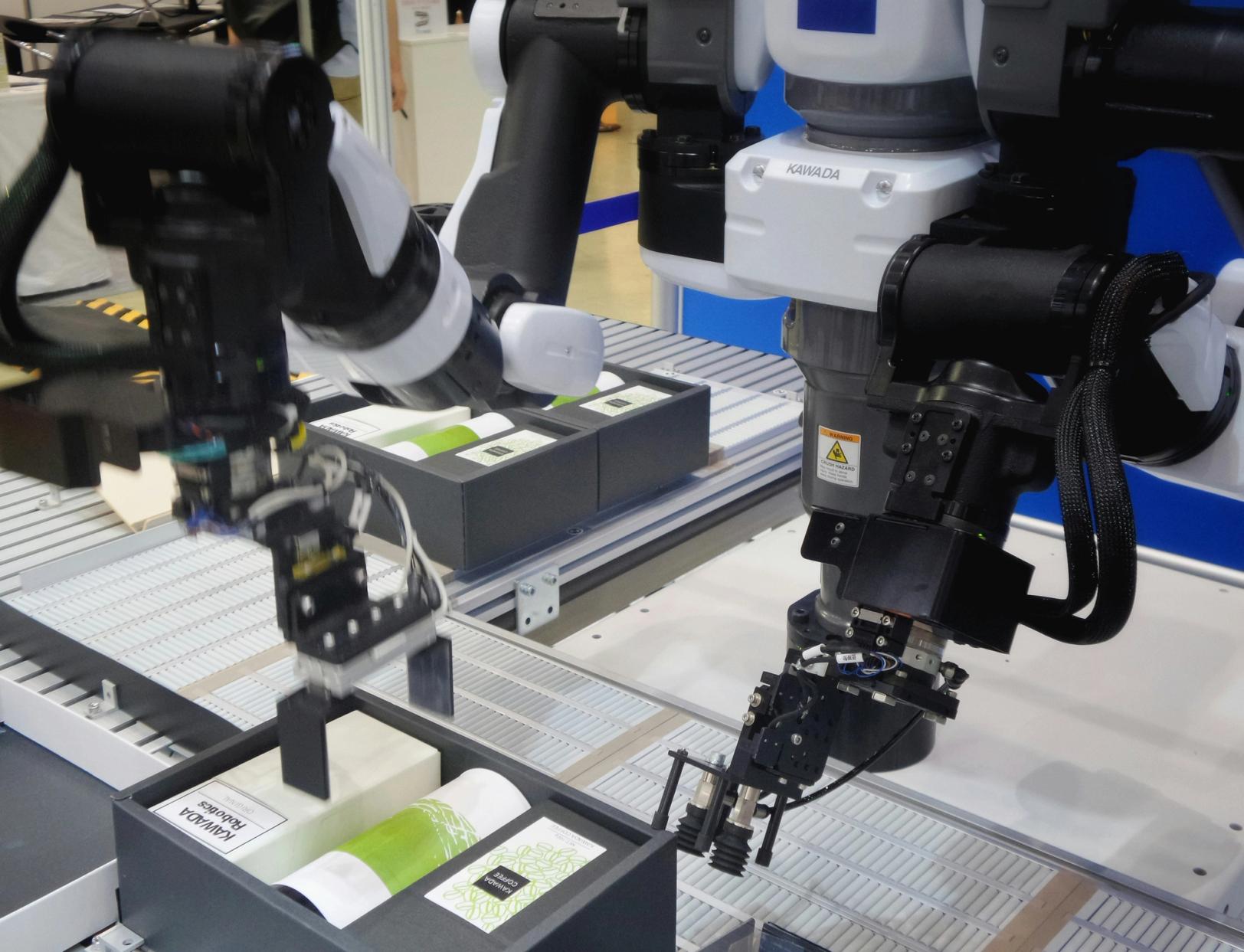
A dual-arm industrial robot handles packaged goods. (Representational image: Franck V. / Unsplash)
Carmaking built industrial robotics, and it is no longer the field's biggest customer. In 2025, general industry, the grouping that covers every sector outside automotive and electronics, took 53% of the world's new industrial robot installations, up from 26% a decade earlier, according to the International Federation of Robotics (IFR). Automotive's share over the same period fell from 38% to 23%.
To show how “the center of gravity of robotics has shifted from automotive to general industry,” IFR groups installations into three: automotive, electronics, and a broad "general industry" bucket for everything else.
- Automotive means the carmakers and their parts suppliers, the plants that first put robots to work welding and painting vehicle bodies.
- Electronics covers the factories making chips, circuit boards, phones, batteries and appliances.
- General industry is everything else: metalworking and machinery, plastics and chemicals, food and beverage, warehousing and more.
It is that last, broadest bucket that now installs most of the world's robots. The three shares account for every one of the 603,307 robots installed worldwide in 2025: automotive 23%, electronics 24% and general industry 53%.
Automotive grew in size but shrank in share
Carmakers did not stop buying robots, and car plants still run the largest installed base of any industry. Figures the IFR press office provided to AUTONOMOUS, from the full World Robotics 2026 report, put the worldwide stock of robots working in automotive plants at 1.36 million in 2025, up from 1.29 million a year earlier and the most of any sector.
In 2025 alone, carmakers installed 138,429 industrial robots, up from 97,533 in 2015, according to IFR. But their share of global demand fell from 38% to 23% across the decade, because demand everywhere else grew faster.
Electronics followed the same pattern: its installations rose from 91,660 to 142,235 units, yet its share slipped from 36% to 24%. In unit terms, that nudged electronics, at about 142,000 robots, just ahead of automotive as the single largest robot-buying industry.
The same is starting to show in the installed base. Electronics plants now run 1.31 million robots, within 52,000 of automotive, and their stock has grown faster over the past two years, so electronics is on course to hold the largest installed base as well as the biggest annual demand.
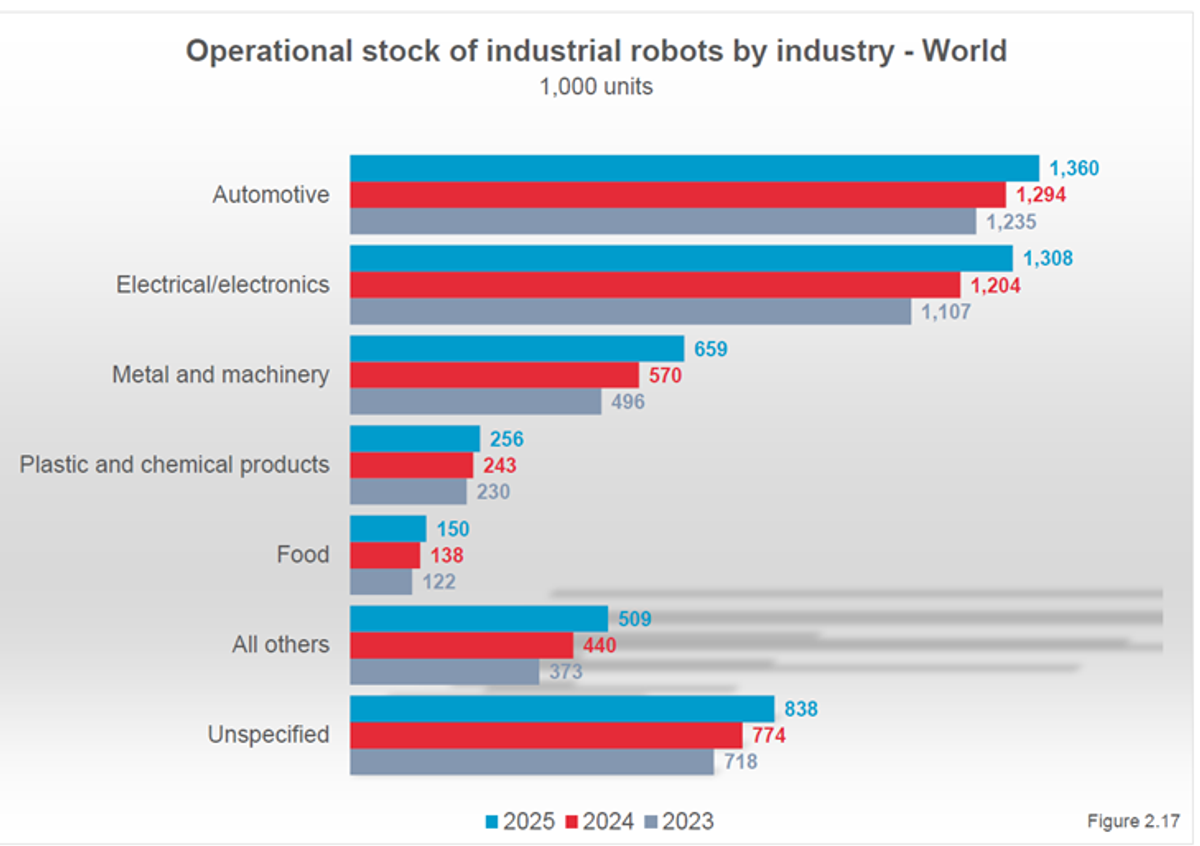
Across all industries, the robots already at work reached a record five million in 2025. The IFR breakdown shared with AUTONOMOUS puts automotive at 1.36 million, electronics at 1.31 million, metal and machinery at 659,000, plastics and chemicals at 256,000 and food at 150,000, with the remaining 1.35 million in other sectors such as warehousing or in plants the report does not classify. Added together, the per-industry figures match the five million total.
The Hands Are Holding Robots Back. We Spoke With Who's Solving This.
Cheaper, simpler robots are reaching new factories
General industry, which spans metalworking, plastics, food and much more, has quintupled over the decade, from 64,555 installations in 2015 to 322,643 in 2025, IFR reports. The fastest-growing of the major sectors in 2025 was metal and machinery, up 22% to about 109,000 units.
The reason is cost and control. Robots have become cheaper to buy and far easier to program, so they now make sense in factories that could never justify a traditional industrial arm: food processing, plastics, metalworking and warehousing.
These sectors are at an earlier stage of automation than carmaking, which means the growth from here comes from a widening base of first-time buyers, not from car plants adding to an already large installed base.
7,000 humanoid robots sold in 2025; forecasts say 1.2 million a year by 2030
What it means for humanoids
The shift also reframes the case for humanoid robots. The pitch for a general-purpose machine rests on the idea that there is a vast field of work in general industry that conventional robots cannot reach economically.
The IFR data cuts against that. Fixed and collaborative robots are already pouring into general industry, cheaply, and in the hundreds of thousands. The ground a humanoid is meant to claim is shrinking, not growing.
Simply put, car plants built the robot industry over four decades. The robots now spreading to everyone else are not humanoids. At least, not this year.
Read next


The event
AUTONOMOUS 2027
The conference behind this reporting: April 13-14, 2027 at Pier 27, San Francisco. Two days of founders, engineers and investors building robotics and physical AI.