May Mobility plans more than 10,000 self-driving Volkswagen ID. Buzz vans by 2031
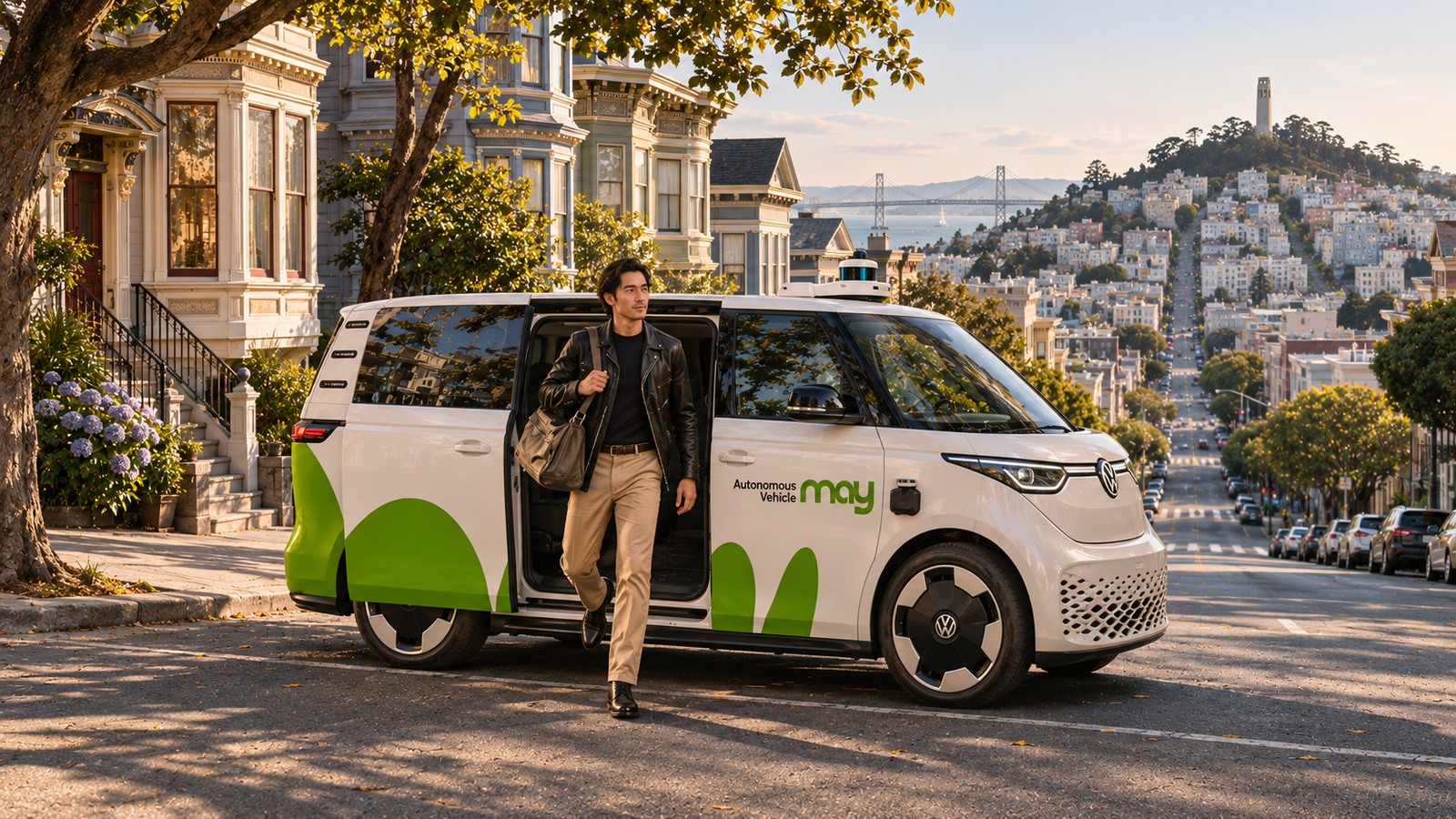
May Mobility will fit its autonomous driving kit to the all-electric Volkswagen ID. Buzz and deploy the vans with fleet operator partners. Testing on US roads starts in early 2027, and the first production vehicles are due in 2028.
Updated 14 November 2026
Key takeaways
- May Mobility targets deployment of more than 10,000 autonomous Volkswagen ID. Buzz vehicles through 2031.
- ECARX will integrate May Mobility's driving system into the van, and Charlton Intelligence.ai will support deployment.
- May Mobility is aiming for all-in cost savings of 50% or more against its current-generation vehicle.
May Mobility plans to put more than 10,000 autonomous Volkswagen ID. Buzz vans into service on robotaxi platforms around the world by the end of 2031.
The Ann Arbor, Michigan company announced the plan on 12 November 2026. It will fit the all-electric ID. Buzz with its own autonomous driving kit and deploy the vans with its fleet operator partners.
How the robotaxi programme will work
The plan covers ID. Buzz vehicles adapted to the design requirements of May Mobility's autonomous driving kit. May Mobility said this gives it a production platform suited to scaling fleets of driverless vehicles.
ECARX, a Nasdaq-listed automotive technology company and an existing May Mobility ally, will integrate the driving system into an autonomy-ready version of the van. Charlton Intelligence.ai has joined the partnership to help deploy the vehicles.
Development is already underway. On-road testing in the US begins in early 2027, and the first production vehicles are targeted for delivery in 2028.
May Mobility said its supply chain work with ECARX and Charlton Intelligence.ai supports a target of all-in cost savings of 50% or more compared with its current-generation vehicle. It has not yet published vehicle specifications or named the fleet operators that will run the vans.
For a robotaxi business, the vehicle often decides whether the numbers work. Olson made the same point when he announced the plan, linking the choice of van directly to how far the business can scale.
Why the ID. Buzz
Volkswagen's electric van draws on the design of the original VW Bus. May Mobility pointed to its multiple entry doors, roomy interior and distinctive look as reasons it suits shared rides.
Dr Edwin Olson is chief executive and founder of May Mobility, which he started in 2017. He co-led autonomous driving development at Toyota Research Institute, worked on Ford's autonomous vehicle research and is a professor of computer science at the University of Michigan. He holds a PhD in computer science and engineering from MIT, where he was part of the team in the 2007 DARPA Urban Challenge.
Olson said, "Scaling autonomous ride-hail depends heavily on the vehicle platform, and the Volkswagen ID. Buzz gives us one well suited for it."
He added, "We think riders will love the ID. Buzz running on May Mobility's autonomous driving system, and the vehicle will be built on economics that can scale with the robotaxi market."
A partner-led business model
May Mobility supplies the driving system, while partners own and operate the fleets. The company describes this as an asset-light approach, unlike rivals that build and run their own vehicles.
Its software runs on the vehicle itself. A predictive world model simulates up to 10 seconds ahead, and a reasoning engine compares several driving strategies in real time before choosing one.
The company has completed more than 600,000 commercial autonomous rides across 1.1 million miles in the US and Japan. That total includes three deployments with no safety driver on board, making it one of a small group of companies running public driver-out routes at several US sites.
Its wider partner list includes Toyota Motor Corporation, NTT, Lyft, Uber and Grab. The company sells its technology as a service, so each robotaxi partner can add vehicles without May Mobility owning the fleet.
May Mobility runs commercial service with Lyft in Atlanta and operates rides in Eden Prairie and Grand Rapids, Minnesota. It plans to launch with Uber in Arlington, Texas, in 2027, and began a six-month on-demand pilot with NTT Mobility in Nagoya, Japan, in September.
The ID. Buzz announcement came on the day of May Mobility's investor day, as the company moves towards a planned Nasdaq listing.
Robotaxi market growth
Analysts expect demand for driverless ride-hail to rise quickly in the next decade. Goldman Sachs Research forecasts the global robotaxi market will reach about $415 billion in 2035.
The bank expects the US market alone to reach $19 billion in 2030, sharply up from its earlier estimate of $7 billion. It also projects the global commercial fleet will grow from about 7,000 vehicles to around 1 million in 2030.
Goldman expects that fleet to reach roughly 6 million vehicles by 2035. The bank also noted that leading operators plan to run services in 15 or more cities worldwide by the end of 2026, with some aiming for more than 20.
What comes next
May Mobility said more details on vehicle specifications, testing and deployment will follow soon. The first milestone is US road testing of the robotaxi version of the ID. Buzz in early 2027.
The event
AUTONOMOUS 2027
The conference behind this reporting: April 13-14, 2027 at Pier 27, San Francisco. Two days of founders, engineers and investors building robotics and physical AI.